ELECTRIC CIRCUITS AND ELECTRONICS
An electric circuitAn electric circuit is a pathway for the flow of electrons.
Electric current is a continuous flow of electron through a circuit.

Parts of an electric circuit
-Generators provide the energy that electrons need in order to move.
-Loads are devices that transform electrical energy into other types of energy that we can use.
-Switching devices are used to direct and interrupt the flow of electric current.

Diagrams and symbols

Electrical quantities
Voltage or potential difference
The amount of energy that a generator can transfer to electrons depends on its voltage (V) or electric tension. This is measured in volts (V).
If we want to measure voltage, we can use a volmeter and it must be connected in parallel.

Measuring electric current
Electric current is the number of electrons that flow through the cross-section of a conductor every second. We can express this mathematically as follows: I=Q/t
Electric current is measures in amperes or amps (A) in the International System.
We can use an ammeter to measure electric current connected in series.


Electrical resistance: Ohm´s Law
The resistance (R) of a material is equal to the voltage divided by the intensity of the electic current wich travels trough the material. This ratio, wich is called Ohm's Law, can be expressed as follows: R=V/I

Electrical energy and power
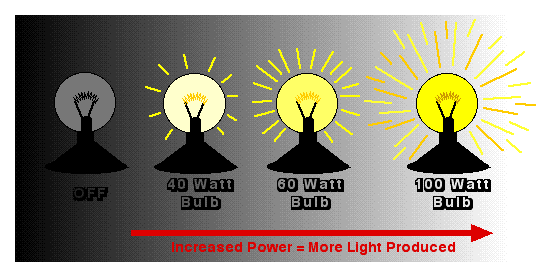
ELECTRICAL ENERGY
If an electric current (I) flows at a particular tension (V) for a certain amount of time (t) we can calculate the energy (E) that is consumed: E= V x I x t
In the SI, this electrical energy is measured in joules (J).

ELECTRIC POWER
The electris power of a load is the amount of energy that it can transform over a certain amount of time.
If an electric current (I) flows at a particular tension (V) we can calculkate the power that is consumed: P=VxI

Series circuit
Two or more elements form a series circuit when the output of one element provides the input for the next element.
To calculate the total resistance of a circuit, we add the resistance values of each load:
R=R1 + R2 + R3+ ...

Parallel circuit
In a parallel circuit, the various components share the same input and output.
If identical batteries are connected in parallel, the voltage of the circuir will not increase. However, the total consumption of energy will be shared between the batteries, so each one will last longest.
The total resistance:1/R=1/R1+1/R2+1/R3+...

Conbination circuit
If a circuit has some elements connected in series and others elements in parallel.

Types of current
Direct current
Between the terminals of a battery, there is a continuos, stable flow of energy. If we use a voltmeter to measure the current in a car battery, the result will always be 12 volt. This is called direct current.--
Alterneting current
Alternating current occurs when charge carriers in a conductor or semiconductor periodically reverse their direction of movement.
The variation of any electrical parameter over a period of time (in this case the electric current) is an electric signal.
The tension or voltage of domestic electricity is an alternating signal because it alternates between positive and negative values. Its waveform is also sinusoidal, with a smooth, regular shape.--

The efficiency of alterning current
The average power of alternating current is equal to the direct current that is needed to produce the same effect. In the case of an alternating sinusoidal current, the average power would be as follow: Vef = Vmax /√2

Transformers
Transformers consist of two windings made of copper wire.
If we apply an alternating current to one of them (V1), it will
produce a certain voltage in the other (V2) The value will
depend on the number of times that the copper wire has
been wrapped around each winding, represented as n1 and
n2: V1/V2 = n1/n2

No hay comentarios:
Publicar un comentario